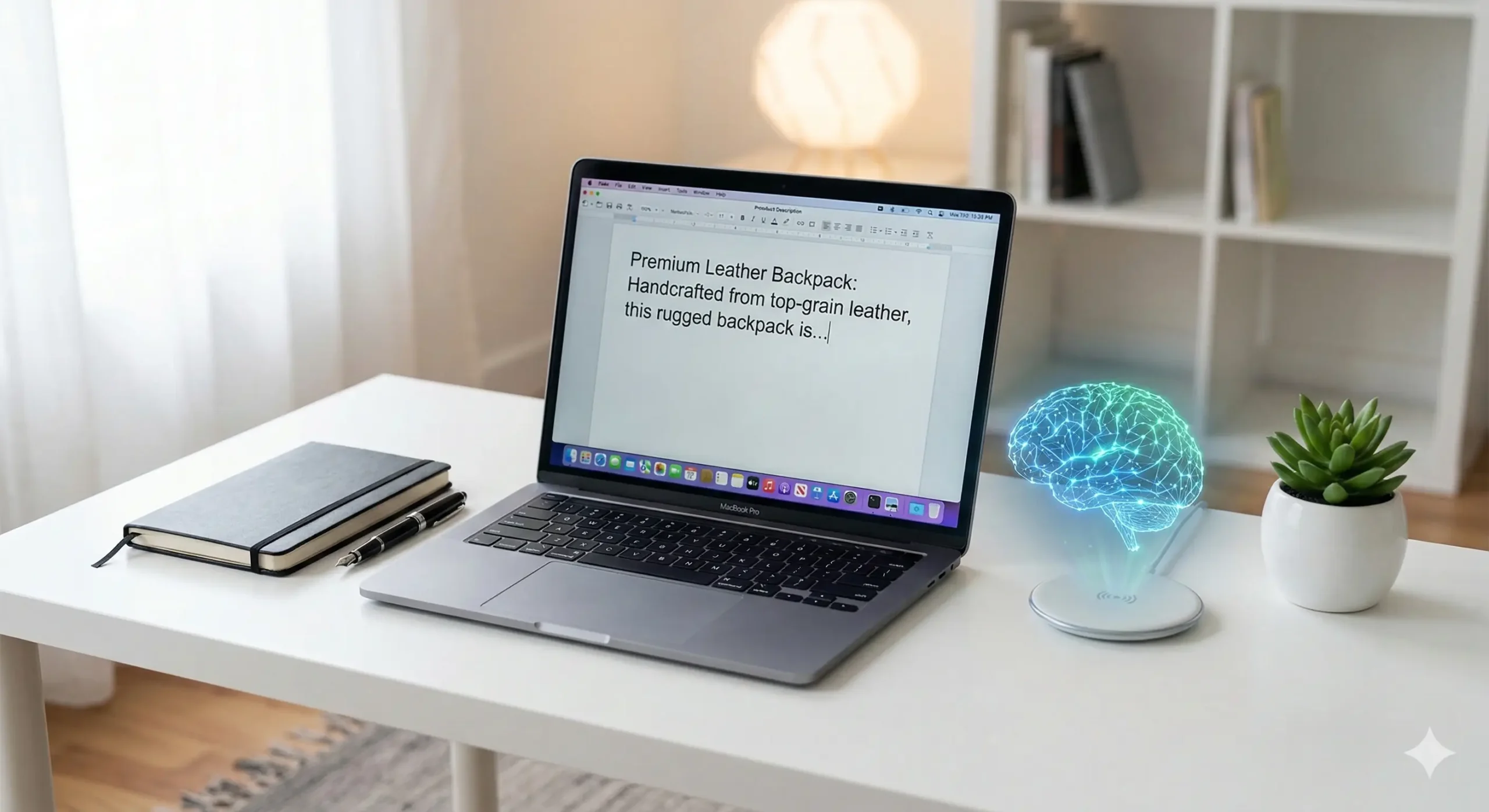
The New Era of E-commerce Copywriting
If you have ever managed an online store with hundreds of items, you know the struggle of writing product descriptions. It is a repetitive task that requires a constant stream of fresh, persuasive, and SEO-friendly language.
Writing a single description is easy, but writing five hundred is like trying to paint five hundred identical miniatures. Eventually, your hand gets tired, and your creative spark starts to dim. This is where Artificial Intelligence steps in as a digital co-writer.
AI tools today are far beyond simple ‘spinners.’ They use Large Language Models to understand the features of your product and translate them into benefits that actually resonate with your target audience.
How the Magic Happens Under the Hood
Using AI to generate descriptions is surprisingly straightforward. You provide the raw data—like material, dimensions, and color—and the AI wraps those facts in a narrative that feels human and engaging.
Think of the AI as a highly skilled chef. You provide the raw ingredients (the specs), and the AI provides the recipe and the presentation. It knows how to season the text with keywords to make it appetizing for search engines like Google.
By analyzing patterns in millions of successful product pages, these tools can mimic different brand voices. Whether you want to sound luxury and sophisticated or rugged and outdoorsy, the AI adjusts its vocabulary accordingly.
The Strategic Benefits of AI Automation
The most immediate benefit is speed. A task that used to take an entire marketing team a week can now be completed in an afternoon. This allows small business owners to focus on high-level strategy rather than getting bogged down in adjectives.
Beyond speed, there is the advantage of consistency. When humans get tired, the quality of the writing often slips. AI maintains the same tone and quality from the first product description to the ten-thousandth.
Insight: AI-generated descriptions can reduce the time-to-market for new collections by up to 80%, allowing you to capitalize on trends faster than competitors.
Comparing AI and Manual Writing
While AI is powerful, it is helpful to see how it stacks up against traditional methods. Here is a quick breakdown of the pros and cons to help you decide on your approach:
| Feature | AI Generation | Manual Writing |
|---|---|---|
| Speed | Instantaneous | Slow and Deliberate |
| SEO Optimization | Built-in & Data-driven | Requires Manual Research |
| Emotional Depth | Good (Template-based) | Excellent (Human nuance) |
| Scalability | Unlimited | Limited by Staff Size |
Improving Your SEO with Intelligent Content
Google values unique, helpful content. In the past, many store owners simply copied descriptions from manufacturers. This led to ‘duplicate content’ penalties that buried their stores in search results.
AI helps you avoid this trap by generating unique variations for every product. Even if you sell ten different blue t-shirts, the AI can find unique ways to describe each one, signaling to search engines that your site is a rich source of info.
Furthermore, these tools can automatically insert long-tail keywords. These are the specific phrases shoppers type into search bars, like ‘waterproof hiking boots for wide feet,’ which are essential for driving high-intent traffic to your store.
Current Trends in AI Adoption
The shift toward automated content is happening faster than many expected. Here are a few statistics that highlight the impact of AI in the e-commerce space:
- Over 35% of online retailers have already experimented with AI for content creation.
- Stores using AI descriptions often see a 15-20% increase in conversion rates due to better readability.
- Nearly 60% of marketers believe AI is the most important technology for their 2026 growth strategy.
Practical Tips for Getting the Best Results
To get the most out of your AI tools, don’t just ‘set it and forget it.’ The best results come from a hybrid approach where the AI does the heavy lifting and a human provides the final polish.
Always double-check the ‘hallucinations.’ Sometimes an AI might confidently state that a cotton shirt is made of titanium. A quick human eye ensures that your customers are getting accurate information every time.
Provide the AI with a ‘Brand Bible’ or specific prompts. Tell it who your customer is. If you sell to Gen Z, tell the AI to be punchy and informal. If you sell medical equipment, instruct it to be precise and authoritative.
The Future of Your Product Pages
We are moving toward a world where product descriptions might even change based on who is looking at them. Imagine an AI that highlights a backpack’s ‘durability’ for a hiker, but its ‘laptop sleeve’ for a student.
By starting with AI now, you are building the foundation for a more dynamic, responsive storefront. It is about working smarter, not harder, to give your customers the information they need to hit that ‘Buy Now’ button with confidence.
Would you like me to recommend a few specific AI tools that integrate directly with platforms like Shopify or Magento?